Dr Chung Kai Li, Associate Professor and Head of the School of Psychology at the University of Nottingham Malaysia (UNM), was invited to speak at the 2nd ASEAN Dialogue on Human Rights and Policing, held at the ASEAN Headquarters in Jakarta from 26 to 27 January 2026.
The dialogue aimed to advance practical cooperation on human rights-based policing across ASEAN, and came off the first ever Dialogue held in Bali two years ago. For the second iteration, it supported the implementation of ASEAN Intergovernmental Commission on Human Rights (AICHR)’s priorities and regional commitments, with a special focus on efforts to reinforce trust, accountability, and professionalism in law enforcement.
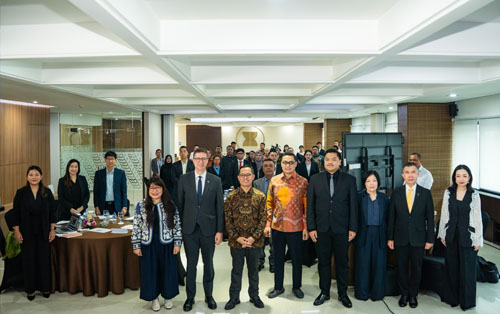
It was attended by 54 participants from AICHR, national police forces, as well as national human rights institutions, civil society organisations, relevant government agencies, academia, and more.
During a panel session, Dr Chung discussed why it is often difficult to translate policing principles from training rooms into real-world practice. She also shared research on how police officers make sense of human rights in their everyday work, and why transferring rights‑based policing principles from training rooms into real policing practice remains a challenge.
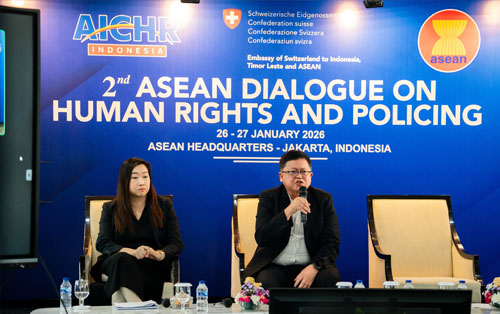
A central focus of her presentation was practical strategies for behavioural and institutional change. These included reframing human rights as enabling rather than restricting the police, supporting officers’ need for fairness and safety, and engaging officers in structured discussions and reflections to deepen understanding.
Dr Chung also stressed the importance of equipping officers with practical communication strategies and translating human rights principles into scenario-based skills that can be applied in everyday policing. Her expertise in this area is further reflected in her co-authored chapter, “Investigative interviewing in Malaysia: Challenges and way forward”, published in the Routledge International Handbook of Investigative Interviewing and Interrogation, which covers various interview and interrogation techniques used around the world with victims, witnesses, and suspected offenders.
Her contribution is a testament to the School of Psychology’s commitment to policy-relevant research that advances accountable and professional institutions. The invitation also reflects growing regional recognition of UNM’s role in shaping evidence-based scholarship across Southeast Asia.
Posted on 4th March 2026