Professor Dominic Foo, a leading scholar in industrial waste reduction, has published the second edition of his textbook, Process Integration for Resource Conservation, further strengthening global efforts to advance sustainable industrial practices.
The second edition was officially launched on 27 August 2025 during the 28th Conference on Process Integration, Modelling and Optimization for Energy Savings and Pollution Reduction, held in Port Dickson. Notably, this marks a full-circle moment for Professor Foo, as the first edition of the book was launched in 2012 at the same conference series, then held in Prague, Czech Republic.
Published by CRC Press (part of Taylor & Francis), Process Integration for Resource Conservation consolidates decades of research and practical toolboxes developed by Prof Foo and his international collaborators from the United States, the Philippines, China, and beyond.
These toolboxes are grounded in Process Integration, a specialised method in chemical engineering design that treats chemical processes as an integrated system rather than individual units. Based on these principles, Professor Foo and his team developed graphical, algebraic and optimisation-based tools that help industrial sectors carry out waste reduction initiatives while enjoying ease of implementation.
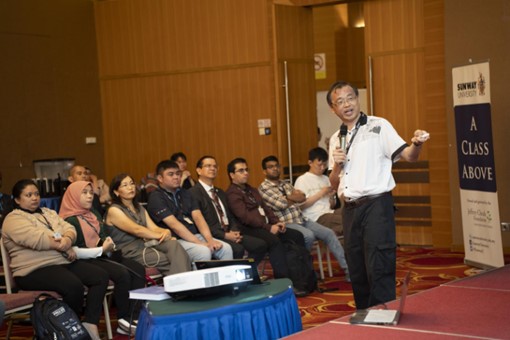
Many of these key process integration tools are now compiled in the second edition of Process Integration for Resource Conservation. Over the years, Professor Foo has conducted workshops around the world including in ASEAN countries, Australia, Korea and South Africa using material from the book to directly support industry practitioners. Engineers from sectors such as chemical processing, power generation, semiconductors, and food and beverage manufacturing are among those who have benefited from his expertise.
The idea of process integration came about as a way to address challenges related to the practising of 3R principles on an industrial scale. The concept of reduce, reuse and recycle (3R) has long been practised across various industrial sectors, driven largely by the growing awareness of environmental sustainability and economic incentives such as cost cutting stemming from waste reduction.
With Prof Foo’s research and dedication, industry practitioners around the world can achieve waste reduction goals efficiently while also doing their part in upholding sustainable practices.
Posted on 20th January 2026