Imagine reprogramming the very cells that help cancer spread, and turning them into microscopic drug couriers that deliver treatment straight to the heart of a tumour. This was among the cutting-edge ideas explored at a joint cancer research seminar hosted by the University of Nottingham Malaysia (UNM) on 12 August 2026. The seminar brought together leading researchers from the United Kingdom and Indonesia alongside key industry specialists to advance the frontiers of oncological science.
Organised by Dr. Ho Wan Yong, Research and Knowledge Exchange (RKE) Initiative Lead for the ASEAN Cancer Research Society and a faculty member of UNM's School of Pharmacy, the seminar, titled Targeting the Tumor Ecosystem: Transcriptional Drivers, Plasticity, and Therapeutic Delivery, provided an open platform for exchanging state-of-the-art diagnostic protocols and oncological theories across borders and disciplines.
Research Findings Presented by Experts
The session opened with Dr. Febrimarsa of Indonesia’s Universitas Muhammadiyah Surakarta, who presented research on how marine organisms can be used to study cancer's stem-cell-like properties, specifically the mechanisms that allow tumour cells to grow and spread uncontrollably. By targeting the cellular systems that govern these properties, his work aims to weaken cancer cells at its core.
Professor Sheela Jayaraman, Professor of Cancer Biology and Gene Expression at the University of Nottingham UK, then turned attention to a pressing regional concern: bile duct cancer, which affects Southeast Asia at significantly higher rates than elsewhere in the world. Her research centres on how a specific protein drives tumour growth in response to bodily signals, a discovery with direct implications for addressing this regional health burden.
Professor Kevin Gaston, Professor of Cancer Sciences at the University of Nottingham UK, presented research on how blood platelets, ordinarily associated with clotting, can be co-opted by tumours to aid cancer's spread. His team has since developed an approach to engineer these platelets to carry cancer-fighting drugs directly into tumour sites, effectively repurposing them into microscopic “Trojan horses” that do good.
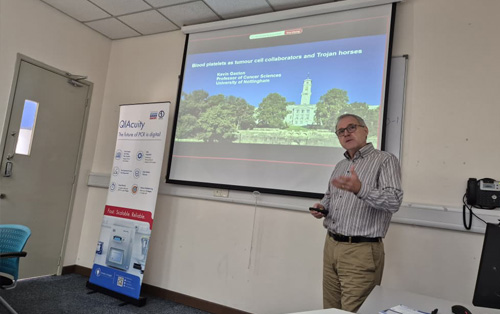
Rounding out the programme, Dr. Khor Yee Min, Associate Sales Application Manager at QIAGEN Malaysia, which sponsored the event alongside supporting partner Impaco PLT, presented advanced DNA and RNA purification methods, underscoring the foundational role of precise sample preparation in aiding scientific breakthroughs.
The seminar stands as a testament to UNM's ability to unite international academic networks with major industry leaders in cancer research. Additionally, it serves as a precursor to the 3rd International Cancer Research Symposium (ICRS 2027), which UNM will host in Kuala Lumpur from 7 to 8 July 2027.
Posted on 24th August 2026