The University of Nottingham Malaysia (UNM) welcomed leading virologists, clinicians and industry researchers to its Semenyih campus on 27 and 28 July for the Rotavirus Vaccine Workshop, the fourth instalment in the Latihan Program Vaksin series. Jointly organised with the National Institute of Biotechnology Malaysia (NIBM) and Biogenes Technologies Sdn Bhd, the two-day programme brought together academia, government, and industry to tackle rotavirus vaccine research, genomic surveillance, and next-generation biosensor technology.
Rotavirus remains a leading cause of severe childhood gastroenteritis and hospitalisation in Malaysia, and the vaccine has yet to be included in the country's National Immunisation Programme, remaining largely a private purchase. On this basis, it was chosen as the highlight of this year’s instalment.
The workshop is testament to UNM’s Health and Wellbeing Signature Strength, and puts the spotlight on the University’s capability to move from bench science (virus culture and genomics) to clinical relevance (vaccine effectiveness) and ultimately to societal impact (child health and national vaccination policy).
In his welcome address to distinguished guests, keynote speakers and participants, Prof Ir Dr Mohd Shahir Liew, UNM's Vice-Provost of Research and Knowledge Exchange, described the workshop as designed to meet these challenges by pairing knowledge-sharing with hands-on laboratory training. Guests included industry partners Adrian Joseph, CEO and co-founder, and Tang Kok Mun, COO and co-founder, both of Biogenes Technologies, alongside Government Research Institute representative Professor Emeritus Datin Paduka Dr Khatijah Mohd Yusoff of the Malaysia Genome and Vaccine Institute, National Institutes of Biotechnology Malaysia.
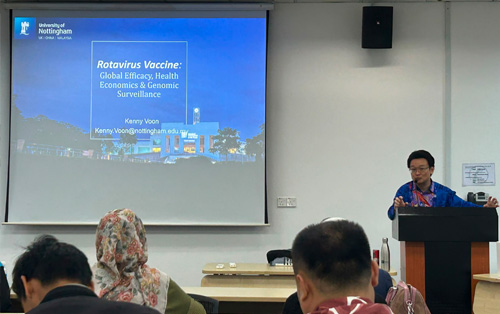
Day one opened with three keynote presentations. Associate Professor Dr Kenny Voon, a virologist from UNM's Division of Biomedical Sciences, reviewed global rotavirus vaccine efficacy, health economics and genomic surveillance, noting that efficacy reaches 80% to 90% in wealthier settings but falls to 40% to 70% in low-income countries, a gap unexplained after more than fifteen years of study. He later led a practical workshop on updated virus culture methods.
Associate Professor Dr Tan Cheng Siang of Universiti Malaysia Sarawak presented findings from an 89-sample molecular epidemiology study conducted in Kuching, revealing a significant genotype shift as the previously dominant G1P[8] strain gave way to emerging equine-like and porcine-like strains. Associate Professor Dr Adli Ali of Universiti Kebangsaan Malaysia examined rotavirus's socioeconomic burden across Peninsular Malaysia, weighing the cost-effectiveness of wider immunisation against the country's current vaccine policy.
Day two turned to applied technology, led by Tang Kok Mun in his capacity as the workshop's lead trainer and forum panelist. He briefed participants on aptamer design alongside trainers Dr Farah Asilah and Nur Aina Syahirah, before a hands-on session on portable biosensors for field detection of rotavirus. The workshop closed with a forum on vaccine and surveillance strategy, moderated by Dr Nor Azfa Johari.
Closing the event, Dr Voon, who chaired the organising committee, thanked NIBM and Biogenes Technologies for their partnership, underscoring UNM's commitment to translating cutting-edge biomedical research into real-world public health impact across Malaysia.
Posted on 19th August 2026