With trade between China and ASEAN having crossed US$1 trillion in 2025, University of Nottingham Malaysia (UNM) helped convene more than 200 leaders from across the region in Nanning, China, to discuss the next stage of economic integration, and made the case that universities play a central role to getting there.
On 17 and 18 September 2026, UNM’s School of Politics, International Relations and Economics (SPIRE) co-organised the China-ASEAN Dialogue on Economic and Trade Cooperation in Nanning, Guangxi Province, alongside the China-ASEAN School of Economics at Guangxi University, Vietnam National University, the China-ASEAN Expo Secretariat, and the China Association for International Economic Cooperation. The Dialogue brought together representatives from international organisations, government agencies, universities, think tanks and businesses from China and ASEAN countries.
The Dialogue marks the latest milestone in UNM’s partnership with Guangxi University, following the signing of a Memorandum of Understanding (MoU) between the two universities in September 2025.
Guest of Honour Speech Charts a Role for Universities
Professor Dr Hazel Melanie Ramos, Vice Provost for Teaching and Learning at UNM, was invited as Guest of Honour to deliver a speech at the opening ceremony, where the China-ASEAN Expo Secretariat launched the China-ASEAN Economic and Trade Cooperation Outlook Report 2026–2027. Commenting on the report, Professor Hazel observed that China-ASEAN economic relations are entering a new stage, defined not simply by greater trade volume but by deeper integration, with bilateral goods trade exceeding US$1 trillion for the first time in 2025.
She pointed to the opportunities created by the China-ASEAN Free Trade Area (CAFTA) 3.0, signed in Kuala Lumpur in October 2025, and to the growing role of artificial intelligence (AI) across supply chains, manufacturing and finance. She also highlighted Malaysia’s position as China’s second-largest ASEAN trading partner, with strong complementarities in the semiconductor sector. Drawing on her research in industrial and organisational psychology, however, she stressed that new trade rules, AI systems and smart factories only create potential, and that firms still need the right people, skills, leadership and learning systems to translate that potential into productivity.
It is here, she argued, that universities have an important role to play. “Guangxi University, the University of Nottingham Malaysia, and the many universities represented here today can contribute not only through research and talent development, but also through interdisciplinary work on AI and governance, executive education, and closer engagement with industry and government,” said Professor Hazel. “Universities can serve as bridges between knowledge, policy and practice, helping to ensure that regional economic integration translates into real capabilities on the ground.”
UNM Academics Contribute Across the Programme
Beyond the opening ceremony, UNM academics engaged directly with regional stakeholders and scholars throughout the two-day programme. Dr Mahmood Ur-Rahman co-chaired the China-ASEAN Youth Economics Dialogue, while Dr Saizi Xiao spoke as a panellist in discussions on regional digital economy collaboration.
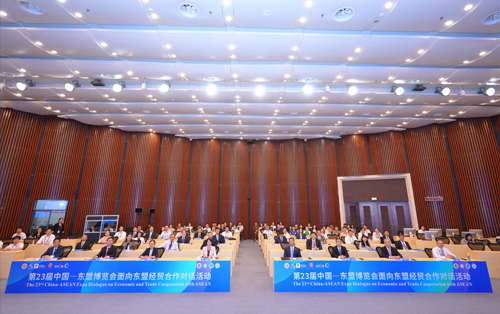
Participants also held in-depth discussions on digital finance cooperation, AI-driven industrial collaboration, and the expansion and upgrading of cross-border trade between China and ASEAN, producing a range of forward-looking and practical recommendations for strengthening regional economic and trade cooperation.
As China and ASEAN look to turn connectivity into capability, UNM’s role as co-organiser and its prominent place on the programme underscore the University’s growing standing as a trusted bridge between the two regions, and its commitment to translating academic expertise into real impact on the region’s economic future.
Posted on 14th October 2026