Learn a New Language
Enhance your degree and level up your language skills by taking a world language module at the University of Nottingham Malaysia. Open to students from all programmes, our language courses offer a fun, structured, and rewarding way to build real-world communication skills.
Our modules are designed to help you grow from Beginner (Stage 1) to Upper Intermediate (Stage 3), focusing on the four key skills – speaking, listening, reading, and writing. You’ll have 3–5 hours of interactive classes each week, supported by digital tools such as Moodle, virtual classrooms, and our Language Resource Centre to enrich your independent learning.
Languages offered:
French
French is spoken by 200 million people in Europe, Africa, North America and Oceania.
It is an official language in 29 countries and will open so many doors for you, whether you intend to travel as a tourist or network for your professional career.
France boasts some world-famous universities and ‘Grandes Écoles’, and our students can gain access to these prestigious institutions. On a more leisurely note, the knowledge of French will allow you to indulge in an attractive culture, see the classic movies in the original, read the latest fashion news and discover some of the greatest works of art.
The French team is dedicated to introducing you to this culture and making your learning as efficient as possible. All tutors have different academic expertise and are well experienced in teaching French as a Foreign Language. Our approach is mainly communicative, and we practice the four language skills (listening, speaking, reading, writing). Level 1 focuses on speaking skills: students are encouraged in speaking from the very beginning of the course. Level 2 focuses on developing students’ listening skills through a variety of media - Radio, TV, etc. Level 3 students focus on formal written production and will further develop their communicative skills. Our aim is to enhance our students’ teamwork and self/peer assessment skills and promote independent learning habits. We offer in-class, out-of-class, and on-line activities, challenging students’ creativity and critical thinking abilities. Our philosophy of teaching is student-centered and we will do everything to help each student fulfil his own potential and reach his own goals.
Extra-curricular activities call for students’ active participation: the French team promotes activities such as the movie nights, language corner, group projects etc. We also try to get native French students involved. This gives our students an authentic language experience and the opportunity to practice in an informal context.
Official Exam
Once students have reached the necessary skills in French, the Language Centre offers them the chance to prepare for the National French Language Proficiency Examinations namely the Diplôme d'études en langue française, Diploma in French Language Studies (DELF).
The DELF and DALF are diplomas awarded by the French Ministry of Education to prove the French language skills of non-French candidates.
There are four independent diplomas, which correspond, respectively, to the six levels of the Council of Europe's Common European Framework of Reference for Languages (CEFRL).
- DELF A1
- DELF A2
- DELF B1
- DELF B2
See more about DELF and DALF exam here.
Japanese
People around the world have long been mesmerised by Japan’s rich cultural heritage, world‑renowned cuisine, natural beauty, cutting‑edge technology, vibrant pop culture, and its reputation for cleanliness and warm hospitality. Whether you are fascinated by Japan’s traditions, intrigued by its business etiquette, or a devoted fan of anime and manga, you will soon discover the subtle beauty of the Japanese language and the culture that shapes it.
Embarking on the journey to learn Japanese opens the door to one of the world’s most delicate and culturally rich societies. From mastering Hiragana and Katakana to exploring advanced grammar and Kanji, students not only learn the four language skills (listening, reading, speaking and writing) through engaging lessons and interactive activities but also gain insight into the social contexts that shape daily interactions in Japan.
Students also integrate their Japanese language proficiency with disciplinary skills acquired in their major, including screenwriting, acting, cinematography, directing, and editing, during their participation in the annual Japanese Skit Contest, a short‑film competition organised by the Japan Foundation Kuala Lumpur and the Embassy of Japan in Malaysia. Check out our talented past years’ winners on YouTube by searching the keywords “Japanese Skit Contest”!
Many of our graduates continue their journey by joining exchange programmes offered by our partner universities in Japan, pursuing postgraduate studies there, securing Japan‑related jobs, and applying their Japanese language skills throughout their careers.
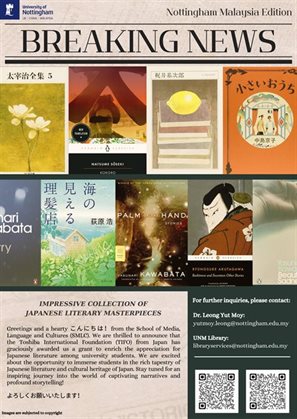
The University of Nottingham Malaysia (UNM) has received a grant from the Toshiba International Foundation (TIFO), Japan, to promote the appreciation of Japanese literature among university students in Malaysia for the 2023–24 fiscal year.
Through the grant, hundreds of Japanese literary books have been made available to the public. The collection includes a wide range of genres—such as fiction, novels, short stories, essays, and historical works—written by authors from the early 20th century to the contemporary era.
For instance, the collection includes the complete works of notable writers such as Akutagawa Ryūnosuke, Miyazawa Kenji, Dazai Osamu, and Kawabata Yasunari, as well as works by recipients of the Akutagawa Prize and the Naoki Prize.
Students at UNM can explore the exciting world of Japanese literature by accessing these books at the UNM Library, while students and members of the public outside the UNM community can borrow the hard-copy books for 2–6 weeks.
UNM is passionately committed to enhancing awareness and appreciation of Japanese literature within the Malaysian higher education community. Should you have any queries about the TIFO Japanese literary book collection, please do not hesitate to contact UNM Library Services libraryservices@nottingham.edu.my. The loans are free of charge; however, delivery fees will be charged accordingly.
Korean
Korean is spoken by approximately 80 million people worldwide, most of whom live on the Korean Peninsula. Although differences have developed between standard varieties used in different regions, especially between the North and the South, it is considered that the language remains largely mutually intelligible. Korean is also spoken by sizeable overseas communities, particularly by the ethnic Koreans in northeastern China, as well as in the United States, Japan, Russia, Canada, and other regions due to historical and contemporary migration. South Korean standard Korean is the variety most widely taught, learned, and used internationally.
Korean is written using Hangul, a phonetic alphabet invented in the 15th century under King Sejong. Designed to be logical and easy to learn, Hangul contributed significantly to the spread of literacy. Its adaptability has also been demonstrated beyond Korea, including initiatives such as its use by the Cia-Cia language community in Sulawesi, Indonesia, as a writing system.
At UNM, Korean is taught using a communicative approach grounded in real-life contexts, focusing on developing all four core language skills (listening, speaking, reading, and writing) through structured lessons, practical interaction, and engagement with authentic materials. Language learning is complemented by exposure to contemporary Korean media and culture, including dramas, films, and popular music, which enhances understanding of how the language is used in social contexts.
Studying Korean can open opportunities in academic, cultural, and professional fields. Korean language proficiency is valued in areas such as international business, technology, tourism, media, and global organisations connected to Korea.
Official Exam
The Test of Proficiency in Korean (TOPIK) is the official national examination that evaluates Korean language ability for non-native speakers. It is administered by the National Institute for International Education (NIIED) under the Ministry of Education in Korea and is offered internationally. The test assesses proficiency in listening, reading, and writing, with levels ranging from beginner (TOPIK I) to advanced (TOPIK II).
- Official TOPIK website (Korea): https://www.topik.go.kr
- Information website for TOPIK in Kuala Lumpur, Malaysia: https://blog.naver.com/koreaukm
TOPIK certification is widely recognized by universities, employers, and institutions, and can enhance academic and career prospects for learners of Korean.
Mandarin
Mandarin opens doors to global opportunities. As the world’s most spoken first language and a major language of international business, media, and technology, Mandarin is an invaluable skill for students seeking to stand out in a competitive global landscape. At the University of Nottingham Malaysia (UNM), students can begin or advance their Mandarin learning journey in a supportive and culturally rich environment.
Studying Mandarin in Malaysia allows students to engage with the language in real-life settings, both on and off campus. Daily exposure to Mandarin-speaking communities helps build confidence, fluency, and cultural understanding, while preparing students for future careers in multinational and multicultural contexts.
UNM’s Mandarin courses, taught by experienced academics, cater to learners from beginner to upper-intermediate levels and focus on developing strong communication skills across listening, speaking, reading, and writing. To further enrich the learning experience, students may have the opportunity to participate in exchange programmes in Taiwan and China, allowing them to immerse themselves in Mandarin-speaking environments and deepen their linguistic and cultural understanding. In addition, students can engage in a range of extracurricular activities, including Chinese cultural workshops and one-to-one online tutoring with native speakers, ensuring a well-rounded and engaging language learning experience.
Official Exam
Once students have attained the required level of proficiency in Mandarin, the Language Centre offers them the opportunity to prepare for the Chinese Proficiency Tests (HSK and HSKK), which are internationally standardised examinations that assess and certify Chinese language proficiency.
These tests evaluate non-native Chinese speakers’ ability to use Mandarin effectively in daily, academic, and professional contexts.
For more details, please visit to HSK & HSKK website.
What are the benefits of learning Mandarin in Malaysia?
Learning Mandarin in Malaysia offers unique advantages due to the country’s multicultural environment and its strategic position in Southeast Asia. Here are several compelling reasons to consider enrolling in this Mandarin language course at the University of Nottingham Malaysia:
- Quality education
UNM offers a well-structured Mandarin programme delivered by experienced academics, supported by comprehensive learning resources and a curriculum designed to develop practical communication skills alongside linguistic competence.
- Regional relevance
Malaysia’s close geographical, economic, and cultural ties with China and other Chinese-speaking regions make Mandarin a highly relevant language to learn. As China continues to play a significant role in regional and global trade, Mandarin proficiency is an increasingly valuable asset.
- Networking and career opportunities
The ability to communicate effectively in Mandarin opens doors to a wide range of professional opportunities, including careers in business, education, tourism, diplomacy, and international organisations across Malaysia, Southeast Asia, and China.
- Multicultural learning environment
Malaysia’s multilingual society provides students with frequent opportunities to practise Mandarin in real-life contexts. Regular exposure to Mandarin-speaking communities enhances language confidence, fluency, and cultural understanding beyond the classroom.
We invite you to broaden your horizons, enhance your employability, refine your language skills, and support your personal and professional development by enrolling in our Mandarin course today.
Spanish
Spanish is the world’s fourth most spoken language, only preceded by English, Mandarin and Hindi. Also known as Castilian (castellano), it is the official language in 21 countries and is widely spoken in places such as the United States, Western Sahara, the Philippines, and Morocco.
At UNM, we adopt a communicative approach based on real-life scenarios. Students develop all four language skills - listening, speaking, reading, and writing - enhancing both their linguistic and intercultural competence. Combined with a proven teaching structure, this approach offers a rich learning experience and the opportunity to communicate with more than 500 million Spanish speakers worldwide.
Official Exam
The Diplomas in Spanish (DELE) are official qualifications certifying proficiency and mastery of the Spanish language, granted by the Instituto Cervantes on behalf of Spain’s Ministry of Education and Vocational Training.
DELE diplomas are recognized as the official certification of Spanish language competence for any professional or academic activity requiring an appropriate level of proficiency. Furthermore, they complement statutory foreign language education programs in many countries and institutions and serve as a valuable tool for personal advancement in academic and professional spheres.
In Malaysia, the exams are administered by Aula Cervantes Kuala Lumpur and are held in May and November each year. For updates and latest news, please visit their page here.
At UNM, we’re passionate about helping you succeed in today’s global world. Discover how learning a new language can complement your studies and open new doors for your future